

Specification Project Life Cycle
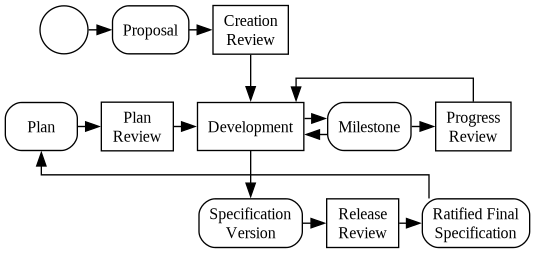
Like regular Eclipse open source projects, a specification project starts life as a proposal with a description, scope, list of committers, and more; goes through an iterative development cycle that produces one or more milestone builds; and then engages in a release process.
Specification Committee
Unlike a “regular” Eclipse open source project, a specification project must be aligned with exactly one working group. Each working group designates a specification committee that maintains and manages the specification process on the working group’s behalf. A specification project must get approval from the corresponding specification committee to pass key project life cycle events.
The specification committee is ultimately responsible for ensuring that the final specifications produced by their working group’s specification projects make sense. The definition of “makes sense” varies by specification committee and specification committee participant, but is generally understood to mean ensuring that the specification teams keep within their defined scope, that the specifications they produce can be implemented, and that those aspects of the Eclipse Intellectual Property Policy with regard to essential claims are observed. In practical terms, specification committee participants wield power via the ballots that are required to approve key life cycle events per the EFSP.
The Specification Committee is responsible for producing, publishing, and maintaining operational guidance documentation for specification projects. This includes the minimum requirements and process for producing a final specification. It also includes operational guidance for running a specifications TCK for the purpose of testing for compatibility.
The Specification Chair (or their delegate) is responsible for initiating ballots, tallying their results, disseminating them to the community, and (when appropriate; e.g., in the case a release review ballot) reporting them to the EMO.
The Specification Committee is also responsible for defining and refining how they implement the EFSP for those specification projects under their purview.
Specification Committee Ballots
The specification committee is required to engage in a formal ballot to approve key milestones in the life cycle of their specification projects. The exact means by which ballots are run varies by working group. The following life cycle events require the approval of the working group’s specification committee:
- Specification project creation;
- Release plan;
- Revision to the scope;
- Progress and release reviews;
- Service releases; and
- Designation of a profile or platform.
By default all ballots require seven days. Some specification committees may increase the length of time for some or all ballots, or add additional constraints.
To succeed, a vote requires positive responses from a supermajority (defined as two-thirds) of the members of the specification committee. Votes to designate a specification as a profile or platform require positive responses from a supermajority of the specification committee members who represent the interests of Strategic Members of the Eclipse Foundation. It’s worth noting that there is no veto.
The criteria by which representatives decide how they’re going to vote varies by individual and according to the values of the individual and the organisation that they represent (if applicable). Minimally, the specification committee is expected to use their vote to ensure that specification projects stay within scope. In the case of a progress review, the voters will need to consider whether or not the project is progressing in a manner that will eventually result in a successful vote on the eventual release review that gates the ratification of the final specification.
In the event of a failure, the specification committee will provide feedback regarding the reason for the failure to the project team, who will work to mitigate issues and then re-engage.
Creation Review
Creation reviews give the community a last opportunity to review and comment on a new project proposal before it is created.
The specification committee needs to approve of the creation of a specification project from a proposal by taking a role in the creation review. The expectation is that the specification committee members will consider the details of a proposed specification project (with particular focus on the scope) before making their decision. In addition to the requirements defined by the Eclipse Foundation Development Process (EDP), a supermajority ballot of the entire specification committee is required to approve a creation review.
Tip: Contact the EMO to initiate a creation review.
Following successful creation and provisioning of project resources, a specification project team begins development.
Specification Development
During the development cycle, the project team will produce one or more milestone builds to provide a means for the community to provide feedback.
Warning: A milestone build must never be used to claim compatibility with a specification. An implementation of a specification may only be considered compatible when it is based on a final specification.
A development cycle begins when a either a creation review or a plan review is declared successful. A specification project team must engage in a progress review when a development cycle exceeds one year in duration.
Progress Review
For a progress review, the Project Management Committee (PMC) and Eclipse Management Organization (EMO) validate that the specification project team is following the EDP and EFSP, and that the Eclipse Foundation’s Intellectual Property Policy is being correctly implemented. The EFSP requires that the specification committee approve a progress review by supermajority ballot.
Note: The intent of the progress review is to ensure that the specification project is progressing in a manner that will ultimately result in a successful release. A specification committee or project leadership may compel a specification project to engage in additional progress reviews.
Release Review
A specification project team must engage in a release review for every release (major, minor, and service).
At the end of every development cycle, the project team must produce a release candidate build that is designated as a specification version and then engage in a release review. For a release review, the PMC, EMO, and specification committee all engage in the same sorts of activities that they do for a progress review, but with the understanding that approval results in the ratification of the specification and promotion to an official status. The EFSP requires that the specification committee approve a release review by supermajority ballot.
Tip: To engage in a release review, create a release record (if one has not already been created as part of the planning process) and contact the EMO to schedule the review. Your PMC and specification committee may provide additional requirements and documentation that must be met to get their approval of the review.
Plan Review
Following a successful first release (and every subsequent release thereafter), and before engaging in any further development of the specification, the project team must assemble and present their Plan for review by the Specification Committee via Plan Review. The notion of a Plan Review is specific to the EFSP (since Plan Reviews are not part of the EDP, no formal involvement from the PMC is required). A Plan Review provides the Specification Committee with an opportunity to ensure that the plan for the next Specification Version is in-scope, fits within the overall vision of the Working Group, and is otherwise charting a path to eventual ratification and release. The EFSP requires that the Specification Committee approve a Plan Review by supermajority vote.
The plan itself must be in-scope (that is, all new work must fall within the bounds defined by the specification project’s scope) and must be developed in consideration of the concerns of stakeholders. It must, for example, take plans of the PMC or associated working group into consideration . The concerns of the project team must also be taken into consideration when creating a plan.
Tip: To engage in a plan review, create a release record and contact the EMO to schedule a review.
After the Plan is approved, the Project Team engages in Development as before.
Final Specification
Following a successful release review, the final release version of the specification artifacts are considered ratified and transmogrifies into what the EFSP refers to as a final specification. It is the final specification that must be used to build compatible implementations.
All versions of specifications that are referenced by a ratified final specification must themselves be ratified. The release review for related specification versions may be run concurrently.
Final Specifications and their associated artifacts are distributed under specific licenses. The specification document for the final specification must be distributed as read-only text (e.g., PDF) under the Eclipse Foundation Specification License. The ratified TCK in composite is distributed under the Eclipse Foundation TCK License. Other technical artifacts must be distributed under an open source license (normally the specification project’s license).