

Frequently Asked Questions
The best way to know, frankly, is it communicate with the project team. Specification project teams should make the nature of the project clear in the README files in their repositories.
We do track this in metadata, which we expose in a number of different locations including the PMI project page. For example:

Yes, the specification project team must engage in a successful release review prior to issuing a release of any kind; this includes service releases.
Yes. The specification committee’s supermajority approval of the release is an absolute requirement. Without their approval, there can be no ratification of the final specification, so there can be no release.
Explaining these documents would be a form of legal advice, and we simply cannot provide that. The short version is that we need these agreements and if you want somebody to explain them to you, you’ll need to consult with your lawyer.
You do not need to arrange for your employer to sign the Employer Consent Agreement for Eclipse Specification Projects if you are unemployed, self-employed, or are a student.
If, however, you are employed, and your employer is not a member of the working group, then you must arrange for your employer to sign the Employer Consent Agreement for Eclipse Specification Projects.
If you are not a committer on an Eclipse open source project, to contribute (e.g., make pull requests) to that project, you need to be covered by an Eclipse Contributor Agreement (ECA). If you are already a committer on any Eclipse open source project, then you are already covered by an ECA through your committer agreement and do not need to sign the ECA separately. If your employer has signed the Member Committer and Contributor Agreement, then you are already covered by an ECA and you do not need to sign the ECA separately.
If you are a committer on a project you do not need an ECA to contribute to that project.
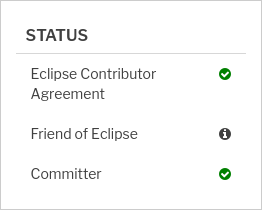
Visit your Eclipse Account page. Your Eclipse Contributor Agreement (ECA) status is shown in the top-right corner.
For example, this contributor is covered by the ECA (and is a committer on one or more Eclipse Foundation open source projects).
If your employer is a member of the Eclipse Foundation, they will be listed on the Eclipse Foundation Membership page.
If your employer is a participant in the working group, then they must have signed the Working Group Participation Agreement, which includes the Member Committer and Contributor Agreement.
If you are unsure whether or not your employer has signed a particular document, please contact the EMO Records Team.
Your status as a committer is not tied to your employment status. Your committer status will not be revoked when you change employers, but it may be suspended while we resolve the legal status of your ability to contribute to Eclipse open source project. You may, for example, require new committer paperwork to reflect your new employment status. If you change employers, please contact the EMO Records Team for help regarding paperwork requirements.
If your employer is not a participant of the working group, your employer must sign the Employer Consent Agreement to provide the necessary legal coverage for you to be a committer on a specification project operating under the purview of that working group. Without this agreement, you cannot have a committer role on a specification project. You may, however, continue to operate as a (non-committer) contributor on specification projects. You may also assume a committer role on Eclipse open source projects that are not engaged in specification development.