A project management committee (PMC) is responsible for the operation of exactly one top-level project as defined by the Eclipse Foundation Development Process. Per the EDP, top-level projects sit at the top of the open source project hierarchy.
The PMC’s role is, fundamentally, to maintain the overall vision and operation of the top-level project and all of the projects that fall within their purview. Very often (though it really depends on the nature of the top-level project), the PMC will take a very active role in determining how their projects fit together, and how they communicate and interoperate. In pragmatic terms, the PMC ensures that projects are following the rules, set the standards over and above the basic requirements for releases and corresponding documentation, approves intellectual property contributions, and approves committer and project lead elections.
Top-level projects do not generally maintain open source content of their own, but rather provide oversight and guidance to those open source projects that fall under them in the project hierarchy. All projects that fall under a particular top-level project must fit within the mission and scope defined by the top-level project’s charter. In addition to mission and scope, the charter may further define other requirements or establish guidelines for practices by the project that fall under its purview.
The primary role of the PMC is to ensure that project teams are implementing the EDP and operating within the terms outlined by the top-level project’s charter. In particular, the PMC monitors project activity to ensure that project teams are operating in an open and transparent manner.
The PMC is responsible for defining and managing the structure of the top-level project and the organisation of the open source (software and specification) projects contained within.
The PMC provides other oversight regarding the operation of open source projects. They review and approve progress reviews, and facilitate cross-project communication within the top-level project.
Composition
A PMC has one or more PMC leads and zero or more PMC Members.
The PMC Lead is appointed by the Eclipse Foundation’s Board of Directors. When an existing PMC Lead retires, the EMO will work with the PMC to identify a replacement and then with the EMO(ED) to have that individual ratified by the Board of Directors.
PMC Members are appointed by the EMO(ED). The criteria by which PMC members are identified varies by PMC, but is generally by nomination and election within the existing PMC. Some PMCs are designed to be composed of representatives from some subset of the projects that operate under their purview. In such a case, the means of identifying members should be documented in the corresponding top-level project charter.
In the unlikely event that a member of the PMC becomes disruptive to the process or ceases to contribute for an extended period, the member may be removed by the unanimous vote of the remaining PMC members, subject to approval by the EMO. Removal of a PMC Lead requires approval of the Board.
PMC Role in the Intellectual Property Due Diligence Process
The Eclipse IP Team has limited technical knowledge and so relies on the PMC to use their relationship with the open source projects operating under their purview, their knowledge and experience with the community and related technology to provide technical insight. Specifically, the IP Team depends on the PMC to use their knowledge and experience with their community and technology to flag any potential issues that may not be obvious.
The PMC might, for example, know that the license for some content had been, at some point in the past, changed; or that some particular piece of content links in some non-obvious manner to other intellectual property that should also be vetted.
Tip: The PMC should not perform any detailed intellectual property analysis of content. The IP Team will engage in detailed analysis, identify license compatibility issues, and determine whether or not license headers have been appropriately applied, for example.
The EMO IP Team will connect with the PMC when their assistance is required.
PMC Role in Elections
The PMC reviews and approves (or vetoes) committer and project lead elections. The role of the PMC is validate that the election was run according to the open source rules of engagement and election process described in the Eclipse Foundation Development Process, and consistent with the Top-Level Project Charter.
In practical terms, the EMO depends on the PMC to validate that elections provide (either via the nomination statement, or by statements made by committers during the voting period) a transparent record of relevant contribution by the nominee and maintain vendor/employer neutrality.
From the EMO’s perspective, any single PMC member can review the election and — if they feel that the election was correctly run — approve it. Any single member can do this on behalf of the PMC. PMCs tend to do this opportunistically: the first PMC member who receives notice of the completed election does a quick review and approves (or not). In the general case, a PMC member will independently review and approve an election; in specific individual cases, the PMC member may decide that further investigation is required and engage with the rest of the PMC for guidance.
Note: The PMC may, at its discretion, add requirements for elections involving projects that operate under its purview. The PMC must capture additional requirements (ideally in the Top-Level Project Charter or in a companion document) and apply them consistently.
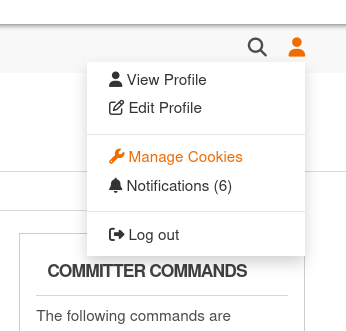
The PMC list is notified when elections require the PMC’s attention. Alternatively, PMC members can review elections that require their attention on the Notifications page.
Tip: Click the Account menu in the top-right corner of your project page to access the Notifications page.
PMC Role in Reviews
As part of the project leadership chain, the PMC is tasked with approving progress, release, and graduation reviews.
The criteria by which the PMC determines whether or not to approve a review, and the process that they follow to grant approval varies by PMC. In general, with this request for approval, the EMO seeks the advice of the PMC regarding whether or not projects under its purview are operating according to the open source rules of engagement. That is, the EMO expects that the PMC has some insight into the operation of the projects operating under their purview, and know whether or not project teams have what they need to be successful.
A project lead or committer must request PMC approval via email to the PMC’s mailing list. Any member of the PMC may approve the review by responding directly to the request with a +1 (that is, the EMO will interpret any single PMC member’s +1 as the PMC’s affirmative response).
Note: The EMO monitors all PMC mailing lists and so will likely observe the PMC’s approval response. The EMO will acknowledge the approval via the issue being used to track the review.
Since any single member of the PMC may approve a review on behalf of the entire PMC, the EMO purposely delays recording the approval in order to give other PMC members an opportunity to challenge their colleague.
PMC Role in Grievance Handling
The PMC is a link in the project leadership chain. As such, the PMC has a role in the grievance handling process: they identify and document project dysfunction (with the responsibility to remove or replace disruptive committers).
The PMC is an important link in the project leadership chain, which is composed of the project’s project lead(s), the leadership of the parent project (if any), the PMC leads and PMC members, the EMO, and the Executive Director of the Eclipse Foundation. In exceptional situations—such as projects with zero active committers, disruptive committers, or no effective project leads—the project leadership chain has the authority to make changes (add, remove) to the set of committers and/or project leads of that project, and otherwise act on behalf of the project lead.