

Release and Progress Reviews
Reviews serve as a means for a project to engage in a retrospective of the progress made, discover areas for potential improvement or mitigation, demonstrate that the project is operating according to the open source rules of engagement (open, transparent, and meritocratic), and ensure that the development process and intellectual due diligence processes are being followed.
Reviews within the Eclipse Foundation can be categorised into: Release Reviews, which are associated with specific software releases, and Progress Reviews, which are not tied to any particular release. A Release Review is a type of Progress Review that is aligned directly with a specific Release. A Release Review must be concluded successfully before the corresponding Release is announced to the community.
Following a successful release or progress review, an Eclipse open source project is considered to be in good standing for a year. Only projects in good standing can make official releases. Specification projects must engage in a release review for every major or minor release.
Note: Historically, Eclipse open source projects were required to engage in a release review before publishing an official release. The notion of a release review still exists, but is fundamentally the same as a progress review.
Progress and release reviews differ only in timing. A progress review can be scheduled at any point in a project’s release cycle; a release review tends to be scheduled at the end of the release cycle.
Progress reviews provide a means for the EMO, PMC, and community to provide feedback and input.
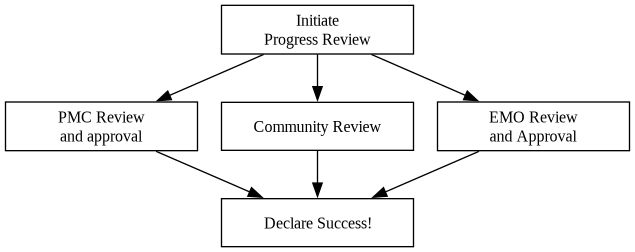
Note: A progress review can be initiated by the project team, by the PMC, or by the EMO.
Send an email to EMO to initiate a progress review.
A progress review provides the EMO with an opportunity to review the project team’s practices to make sure that the the team is doing the right sorts of things to grow the project and attract diversity, has the recommended documentation in place, and is correctly implementing the Eclipse Foundation Development Process and intellectual property due diligence process. The project checklist describes the sorts of things that the EMO looks for when they engage in a review. Note that the checklist is used primarily as a means of identifying opportunities for the project to improve their open source practices and that absolute conformity with the list is considered aspirational, not an absolute requirement.
Note: The EMO is using GitLab issues to track the status of project’s reviews, you can see the template for a Project Review here.
Warning: Intellectual property must be properly accounted for and tracked at all times. All intellectual property must be vetted via the Intellectual Property Due Diligence Process before it it can be included any any release.
The PMC’s role in a progress review is to determine whether or not the project is operating within its scope, and within the mission and scope of the top-level project. The EMO also depends on the PMC to have some sense for how well the project is implementing the open source rules of engagement and is otherwise operating in a vendor-neutral open source project. To engage the PMC, the project lead or a designated project committer should send an email to the PMC’s mailing list with a request for approval of the progress review. The PMC will respond with feedback or a simple +1 indicating approval.
Finally, a progress review provides the community and the Eclipse Foundation Membership with an opportunity to provide feedback and express concerns about the progress of the project.
Note: Eclipse open source projects don’t operate in a vacuum. While a progress review provides an opportunity for the EMO, PMC, and community to have a look at the project, our expectation is that the open source project is operating as part of the community and that all of these parties will have ongoing opportunities to interact and provide guidance.