

Project Phases
Eclipse projects move through various phases. Projects in active phases (incubation or mature) engage in all the normal sorts of development activities: project committers write code, run builds, release software, court contribution, and seek to convert contributors into committers. All new projects start in the incubation phase. Projects tend to stay in the incubation phase for a few months (varies depending on the nature and composition of the project) and then move into the mature phase.
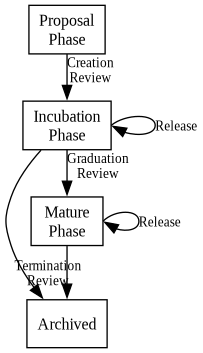
Key project life cycle events are gated by reviews; moving from the incubation phase to the mature phase must be, for example, preceded by a graduation review.
Proposal Phase
During the proposal phase, the EMO works with your project team and community to provide feedback and gather all of the information that we need to create the project. When the project team is ready, we create the new open source project, engage with your committers to make sure that we have agreements in place, provision resources, and work with the project team to transfer their existing code and practices over to the Eclipse Foundation. At this point, your open source project enters the incubation phase.
Incubation Phase
The incubation phase serves as an onboarding period where your project team learns and adopts the principles and practices of the Eclipse Foundation Development Process. Note that the incubation phase is concerned with project teams adopting open source practices that are consistent with the Eclipse Foundation Development Process; the concept of incubation is unrelated to code quality or stability: a project that has stable code base starts in incubation when it is moved to the Eclipse Foundation.
Tip: Onboarding the project as an Eclipse open source project is a process not an event. Everyone knows that your project team won’t get everything right on day one. Steady progress is the name of the game.
A project in the incubation phase is said to be incubating. Incubating projects are encouraged to produce builds, make releases, and grow their community.
After establishing itself as a functioning Eclipse open source project, the project graduates (via graduation review) into the mature phase. The project is probably ready for graduation when your project team has demonstrated that they’re working in an open, transparent, and meritocratic manner; are otherwise engaged in activities that foster vendor neutrality; are faithfully engaging in the IP due diligence process and healthy security/vulnerability management; have engaged in a progress review; and are distributing software.
Mature Phase
Most of an Eclipse open source project’s lifetime is spent in the mature phase, which a project enters after successfully adopting open source practices that are consistent with the Eclipse Foundation Development Process during its incubation period. Reaching this phase provides formal recognition that the project team has demonstrated an open, transparent, and meritocratic process, and has cultivated an actively involved and growing community. In this active state, project committers engage in standard development activities like writing code, running builds, releasing software, and converting active contributors into new committers.
To maintain their standing, mature projects regularly and predictably release high-quality content and actively nurture their communities. As they evolve, projects engage in progress reviews to ensure they continue to operate according to the Eclipse Foundation’s principles.
Archived Phase
When a project has reached its logical conclusion, its resources are archived. Transition in the archived phase is preceded by a termination review.