

Project Lifecycle
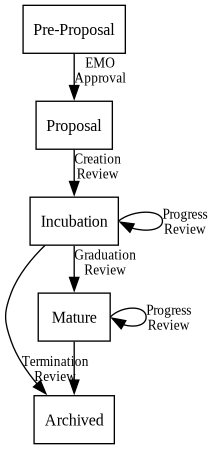
Projects go through distinct Phases. The transitions from Phase to Phase are open and transparent public Reviews.
Pre-Proposal Phase
An individual or group of individuals declares their interest in, and rationale for, establishing a Project. The EMO will assist such groups in the preparation of a Project Proposal.
The Pre-Proposal Phase ends when the proposal is published by EMO and announced to the Members by the EMO.
Proposal Phase
The proposers, in conjunction with the destination PMC and the community, collaborate in public to enhance, refine, and clarify the Project Proposal.
The Proposal Phase ends with a Creation Review, or withdrawal. The Project Proposal may be withdrawn by the proposers at any point before the start of a Creation Review. The EMO will withdraw a proposal that has been inactive for more than six months.
Incubation Phase
Moving a project to the Eclipse Foundation is a process, not an event. All Projects — with the exception to Top-Level Projects — start in the Incubation Phase, independent of code maturity or developer skill. New Projects require time to fully implement this process and correctly implement required policies. The Incubation Phase is a period of time during which a Project Team learns these processes and migrates their practices to align with the Open Source Rules of Engagement and corresponding policies and practices.
The Incubation Phase is an indicator to consumers that the Project may not fully implement practices that are consistent with this process. Projects in the Incubation Phase must annotate Project resources and Release artifacts with Incubation Branding as specified by the EMO.
The Incubation Phase is intended to be short. As a guideline, new Project teams should expect to spend three to six months in the Incubation Phase (longer periods are acceptable, but should considered extraordinary). Projects transition from the Incubation Phase to the Mature Phase following a successful Graduation Review. Projects spend most of their life cycle in the Mature Phase.
The purpose of the Incubation Phase is to establish a fully-functioning open source Project. In this context, incubation is about developing the process, the community, and the technology. Incubation is a Phase rather than a place: new Projects may be incubated under any existing Project.
A Project in the Incubation Phase can (and should) make Releases, engage in Committer and Project Lead elections, and other activities consistent with this process.
The Incubation Phase must not be used as a workaround or excuse to avoid meeting the obligations of this process and implementation of the required policies.
Mature Phase
The Project Team has demonstrated that they are an open source Project with an open and transparent process, an actively involved and growing community, and Eclipse-quality technology. The Project is now a mature member of the Eclipse community.
Archived
Projects that become inactive, either through dwindling resources or by reaching their natural conclusion, are archived. Projects are moved to archived status through a Termination Review.
If there is sufficient community interest in reactivating an archived Project, the Project can start again with a Creation Review. As there must be good reasons to have terminated a Project, the Creation Review provides a sufficiently high bar to prove that those reasons are no longer valid.